
The Layoff Loop
Or: What happens when grief never gets to finish.

This week marks another round of layoffs at Meta. Three years ago this week, I was on the other side of that “Message from Leadership” email. The one that told me I was (thankfully) out. I’ve been reflecting on how those layoffs happened, and what’s fascinating (and a little maddening) is that Meta is roughly the same size today as it was when it let 20,000 people go in the name of efficiency. Three years of hiring to get back to the same spot and then lay off another 8000 people. It feels like a Groundhog Day repeat of organizational disruption, and for many people a massive upheaval in their lives.

But this isn’t really about Meta. I’m not on the inside anymore and I don’t have a pulse on what’s happening in those buildings. And, there are plenty of breathless takes about Meta specifically, so I’m not here to add to that pile. It’s just that this moment has gotten me to pause and look around at the mess of the last few years. Because what I want to talk about is the pattern. Meta isn’t alone. Across tech and knowledge work, we’re watching a shift in how companies relate to the people who build them. And that shift has a name: layoff culture.
The Social Contract Is Cracking
For a long time, the deal was simple. Companies provided stability, health insurance, a sense of purpose if you wanted it, and a place to do meaningful work. In return, people committed. They stayed late. They cared about the mission. They built their identities around the work, because the work was worth building an identity around. That shared sense of purpose caused companies to be bold and go after ambitious things.
But now that contract in knowledge work is cracking, similar to how it has been cracked in other areas over the years. And the message to employees is unmistakable, even if it’s never said out loud: you are a line item, and line items get cut.
I’ve written about the social contract before, and I keep coming back to it because the consequences are compounding. People committed to companies because they were looking for stability and meaning. When both disappear, something fundamental changes in how people show up. And for knowledge work where innovation is the key to staying ahead, that’s a real problem.
Bridges and the Three States
The Bridges Transition Model is my favorite change framework because it focuses on the three different states people experience at any time when going through a significant shift. It, in my humble opinion, rightly asserts you exist in all three vs a typical S, K, or whatever curve. You have all three states at any given time, and it’s just a matter of the percentage each takes up in that moment.
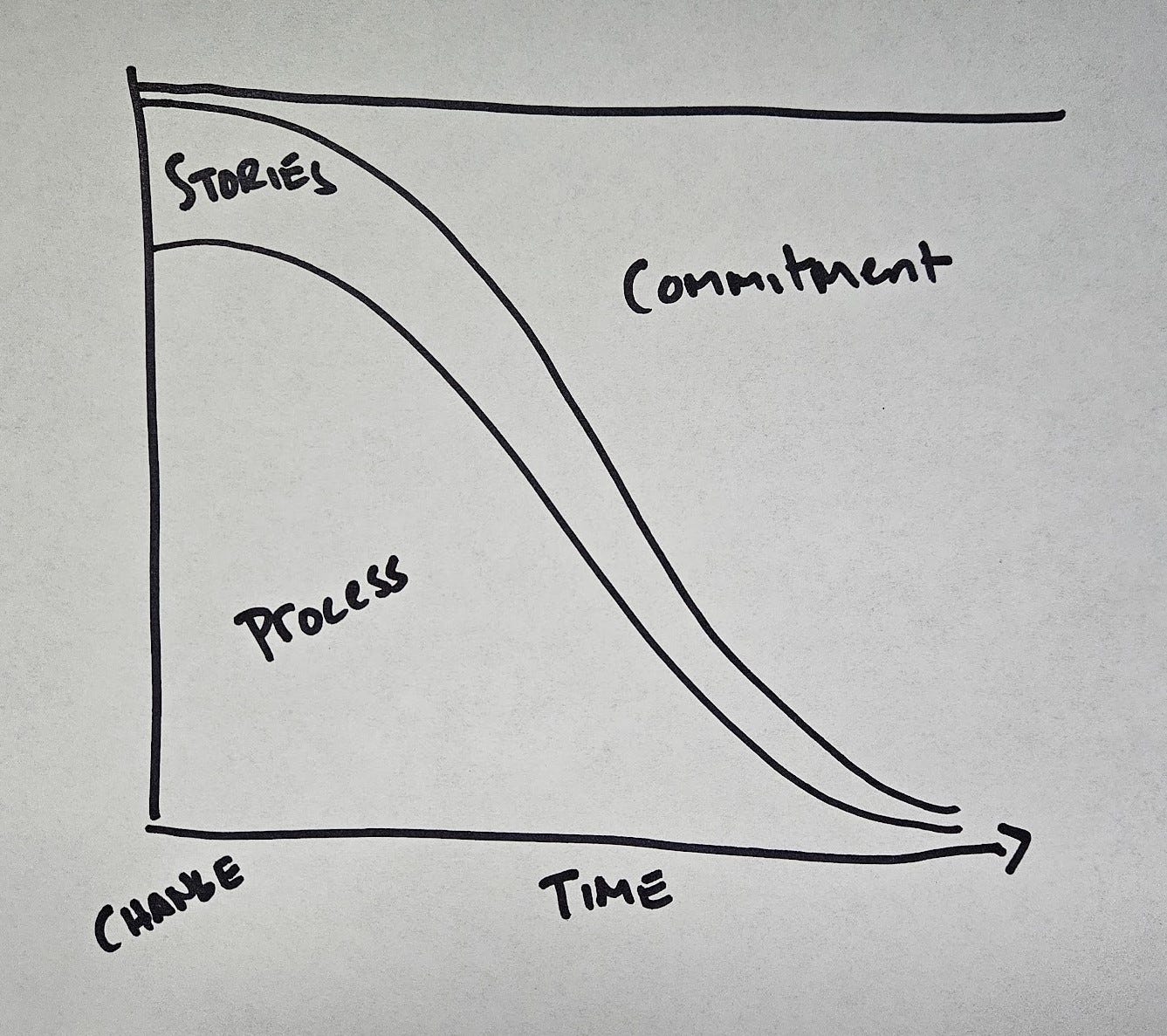
Processing is the grief work. Denial, anxiety, anger, fear. The raw emotional response to something being taken away or fundamentally altered. This is the stage where you’re mourning what was. The before and after.
Storytelling is how you make sense of the change. These stories can pull you backward (replaying what happened, assigning blame, catastrophizing) or they can be generative (reframing, finding possibility, building a new narrative). The direction of the stories matters enormously because it can pull you back down into processing or pull you up into…
Commitment is where you’ve rewired into the new reality. The processing has run its course, the stories have shifted from reactive to constructive, and you’re actually engaged with what comes next. This is where the best work happens.
In a healthy change cycle, the processing and storytelling gradually shrink as commitment grows. You never fully eliminate the first two (every change leaves residue), but ideally the overwhelming majority of your energy shifts toward commitment over time.
But layoff culture creates a gnarly loop.
The Loop
What most people miss about Bridges is that there’s a pre-change ramp-up period. Before the layoff even happens, it is in the air. A CEO announces that cuts are coming on a specific date. Anxiety builds. People start pre-processing, pre-grieving. Will I get the email? What does my life look like after this? Their capacity for commitment is reduced as they start up the storytelling and veering into processing.
Then the moment hits. The emails go out. Processing spikes. Negative storytelling spikes. There’s almost no space for commitment.
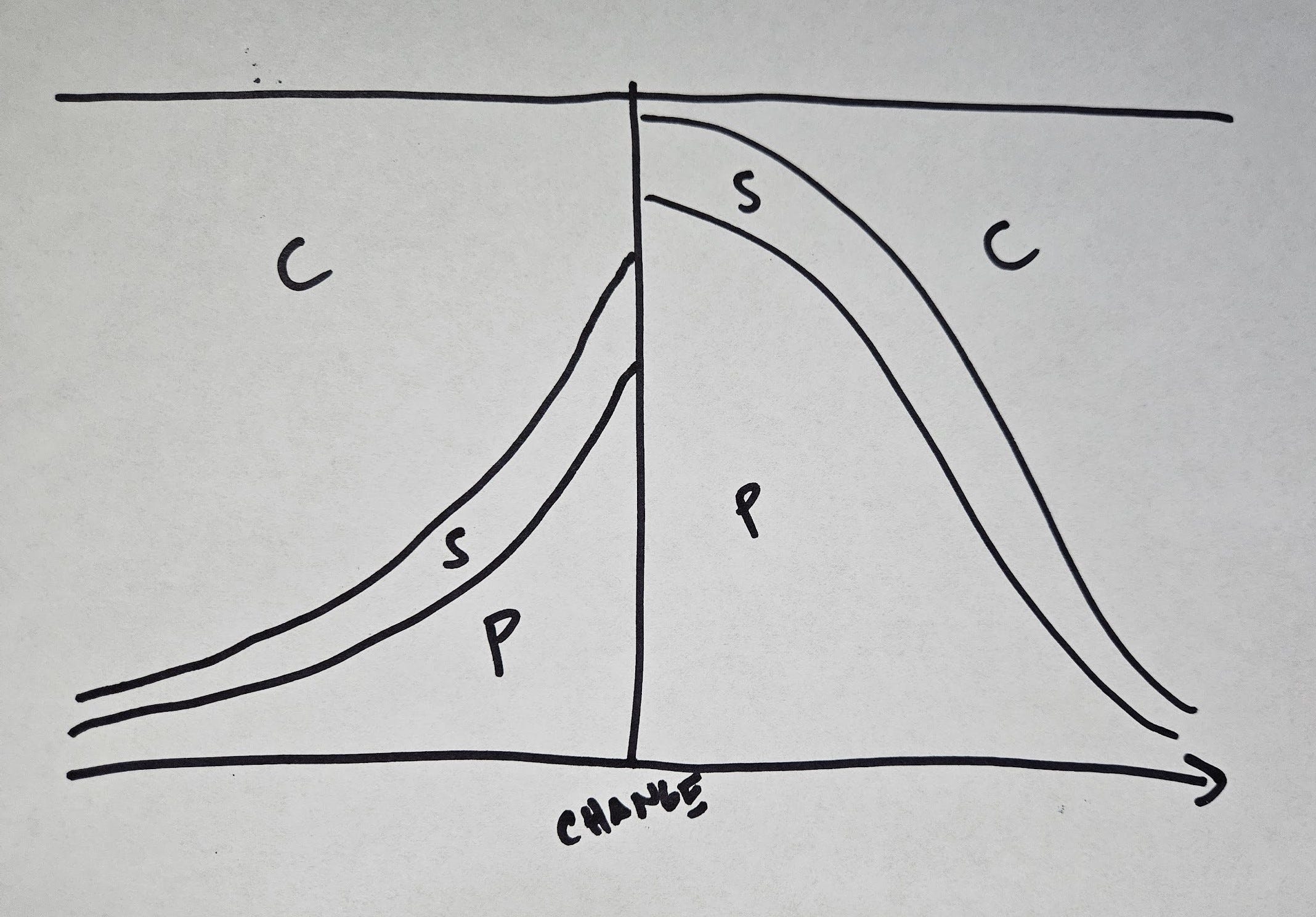
In a one-time event, this is painful but navigable. The processing gradually subsides. The stories shift. Commitment builds back, especially for an organization that is able to acknowledge and move past with better decision making.
But when layoffs happen again. And again. And again?
The cycle breaks. Processing moves into pre-processing for the next round, which moves into processing, which moves into pre-processing for the round after that. Because it’s the same type of change repeating, the brain never gets the space it needs to move through the full cycle. Commitment keeps getting smaller and smaller because there’s no room for it. The grief never gets to finish.
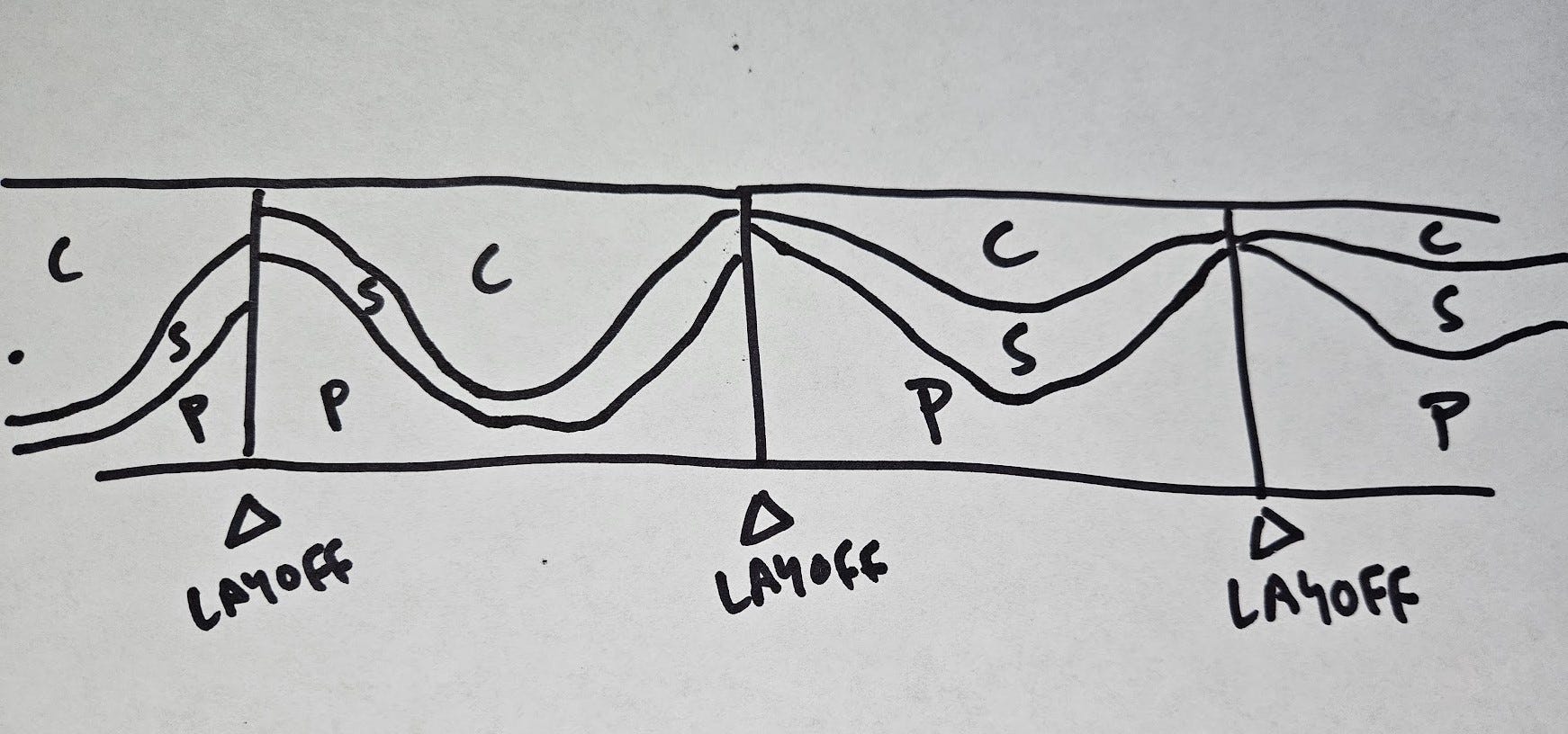
You cannot get great work from people who are stuck in a loop of unfinished grief.
What Gets Lost
I see this in my work, both from my years on the inside and now as an external partner. People who once built these companies with genuine passion and creativity are detaching. They aren’t lazy or disengaged by nature, rather, it’s because the system they’re in has made commitment irrational. Why would you pour yourself into a company that has demonstrated, repeatedly, that your presence is contingent on the next quarterly earnings call? Why would you go above and beyond for a mission that might reorganize you out of existence in six months? When we stop having a sense of agency in an organization, we learn to detach ourselves from it.
We have spent so long treating work as identity. As a source of meaning and self-worth. And now people are watching that identity get shredded by a pattern of cuts that prioritize short-term stock movement over long-term organizational health. The result isn’t just disengagement. It’s a loss of something deeper. People are losing the ability to commit to a company that is not committed to them.
Transactional by Nature
Here’s what I wish more leaders would sit with:
If you want to run a transactional company, run a transactional company. Be upfront about it. Say, “This is the deal. We pay you for your output. The relationship is conditional. Plan accordingly.”
It’s honest. And some companies do it. There are plenty of people who work in transactional companies and get rewarded for it. But, people should be able to make informed decisions about what to invest and where.
What you cannot do is make your culture transactional (or worse, fear-based) through repeated layoffs and then gnash your teeth wondering why people aren’t showing up for happy hours. Or, why they’re not volunteering for stretch assignments. Or, why they’re not building relationships across teams or contributing to culture-building initiatives.
You made the terms of the relationship clear through your actions. People heard you. And they responded rationally: with a transactional relationship of their own. You can’t talk about a purpose driven company that expects everyone all in when you treat them like line items.
The Long Game
I get it. Sometimes layoffs are necessary. Hard choices have to be made. I’m not arguing that companies should never reduce headcount. But there is a canyon of difference between a difficult decision made with care and a culture of layoffs used as a recurring lever to satisfy Wall Street.
Short-term, it might look great. But for companies that believe they’re going to be generational and around for the next fifty years? I think the long-term cost is being wildly underestimated. You cannot build a generational company with a workforce stuck in a grief loop. Innovation doesn’t work with people operating from fear. And guess what? We know where this is headed. Companies that have done this previously are now languishing. Look at the US auto industry - they’ve fallen behind in innovation because they were once purpose driven and then moved to a culture of layoffs and closures.
Sitting With It
So I sit with this. My heart goes out to everyone at Meta who is waiting for that email, or who has already received it. And to the tens of thousands across tech and knowledge work who have been through this cycle over the last few years. The grief you feel, whether you stay or go, is natural. It’s understandable. It comes in all different forms, and none of them are wrong. And, you’ll have reduced capacity in that processing. It’s part of the rewiring of the brain. Try to give yourself some grace as you navigate the change.
And, please know that there is life after a layoff. If you need someone to talk to (even if we never crossed paths), I’m happy to make my time available. Sometimes you just need someone who’s been through it to hold some space and go WTF.
And for the leaders making these decisions: I’d love to hear how you’re thinking about the long-term impact. What are you doing to break the loop for the people who stay? How are you creating space for commitment when the system keeps adding to the grief? How are you keeping your integrity intact and recognizing the dignity of others? Layoff work is heavy and takes a toll.
Because the question I keep coming back to is a simple one: at what cost?
And as always, I’d love to work and especially in this case, just chat if you need it. Feel free to reach out if you want a sounding board or partner in this wild, weird world between AI, HR, and development.
https://calendly.com/savillecoaching/30connect
Glossary: https://savillecoaching.substack.com/p/glossary-of-terms